










Haunted Movie Review:
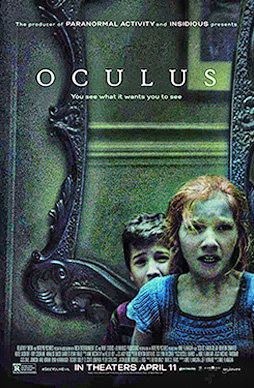
Oculus (2013)
Back to the Haunted Movies Index
Error! You must specify a valid width to use this shortcode!
Director
Mike Flanagan
Writer(s)
Mike Flanagan … (screenplay by) &
Jeff Howard … (screenplay by)
Mike Flanagan … (based on a short screenplay by) &
Jeff Seidman … (based on a short screenplay by)
Cast
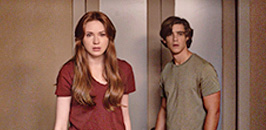
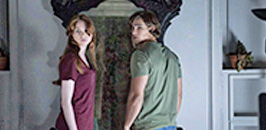
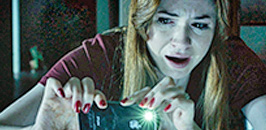
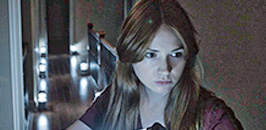
Karen Gillan … Kaylie Russell
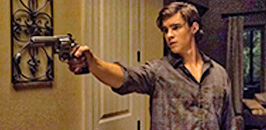
Brenton Thwaites … Tim Russell
Katee Sackhoff … Marie Russell
Rory Cochrane … Alan Russell
Annalise Basso … Young Kaylie
Garrett Ryan … Young Tim (as Garrett Ryan Ewald)
James Lafferty … Michael Dumont
Miguel Sandoval … Dr. Shawn Graham
Kate Siegel … Marisol Chavez
Plot
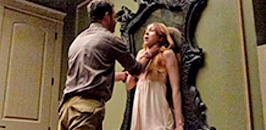
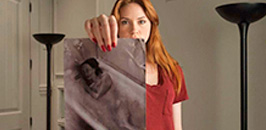
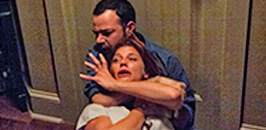
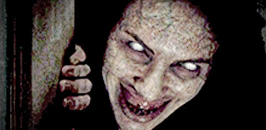
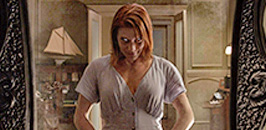
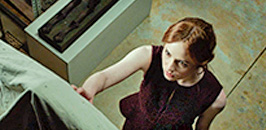
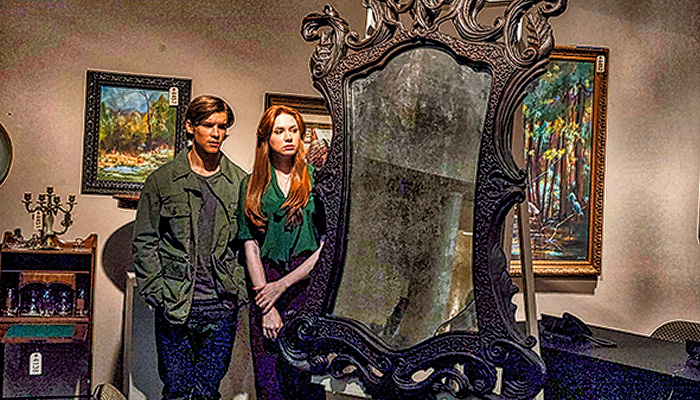
Ten years ago, tragedy struck the Russell family and Tim was convicted of the murder of his parents. Now in his 20s, Tim has been released from protective custody and only wants to move on with his life, but his sister Kaylie – still haunted by that terrible night – is convinced that her parents’ deaths were caused by something else altogether: an evil supernatural force acting through an antique mirror in their childhood home. Determined to prove Tim’s innocence, Kaylie tracks down the mirror, and learns that similar deaths have befallen its previous owners over many years. With the mysterious entity now back in their hands, Tim and Kaylie soon find their hold on reality under assault by horrific hallucinations, and they realize that their childhood nightmares are beginning all over again.
Memorable Lines
Alan Russell: I’ve met my demons and they are many. I’ve seen the devil, and he is me.
****
Kaylie Russell: [after uncovering the mirror] Hello again! You must be hungry.
****
Kaylie Russell: I found it!
Tim Russell: What do you mean?
Kaylie Russell: We only have few days.
Tim Russell: A few days for what?
Kaylie Russell: To keep our promise. And kill it.
****
Tim Russell: Look, Kaylie, you can deal with this; I did. You want to redeem the family name? You don’t need to do it for mom and dad; you only need to do it for yourself.
Kaylie Russell: Oh! They did a bang-up job on you in there, didn’t they? You were perfectly normal when they locked you up. You had to go bat-shit to get out.
****
Thoughts from the HauntedHouses.com team
Regardless of any supernatural elements, the richest horror films tend to be ones that tap into more earth-bound fears. Jacques Tourneur’s Cat People (1942) and I Walked With a Zombie (1943) hinge on their heroines’ dread of being vulnerable to sexual predators. George Romero’s “Living Dead” cycle plays on the fear that such established social institutions as the nuclear family, the military, and capitalism will prove meaningless in the event of catastrophe.
Oculus, a cleverer-than-average haunted-house movie currently in theaters, speaks to a couple of widespread anxieties—one topical, the other sadly timeless. Director Mike Flanagan integrates these concerns into the horror-movie mechanics with some grace, making for a more involving entertainment than Insidious or The Conjuring, recent haunted-house films by his contemporary (and Saw alumnus) James Wan.
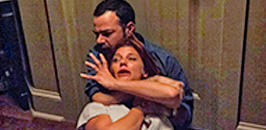
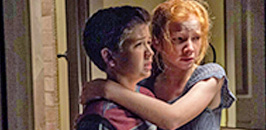
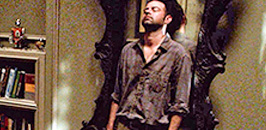
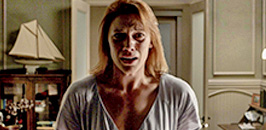
A brother and sister in their early 20s reunite at their suburban childhood home, where their parents died gruesomely about ten years earlier. The sister is convinced that the parents were turned into homicidal maniacs by a haunted old mirror in the father’s study; through research, she’s discovered that everyone who owned it over the past three centuries has died in some macabre way. She sets out to prove her theory by locking herself and her brother in the house and setting up a network of cameras to document the mirror’s supernatural powers. The brother, who spent his childhood in juvenile detention for killing the father in self-defense, at first finds her theory incredible, insisting that she’s constructed a supernatural fantasy to explain how their parents became psychotic—in a nice reversal of the horror-movie cliche, the sister is more intrepid and the brother more ruminative. Of course he changes his tune when spooky stuff begins to happen.
At times Oculus suggests an allegory for how children compensate for being powerless to stop incidents of domestic violence. It also seems to critique a common information-age presumption that we can become neutral observers of our lives if we document every aspect of them. One way the mirror intimidates the siblings is by making them hallucinate horrific events, and some of the more effective scares occur when they find themselves unable to locate records of things that they (and we) believe to have happened. These moments display a smart, self-reflexive approach to film editing, as Flanagan cuts away from some grisly image to reveal it was only a hallucination. The sinuous narrative structure is skillful as well, snaking between the present and events leading up to the original traumatic episode.
As in Jacques Rivette’s self-reflexive masterpiece Celine and Julie Go Boating, the two time frames begin to overlap in the movie’s second half, with the adult siblings appearing to interact with people from their childhood. This development might reflect how victims of childhood trauma are condemned to relive their worst experiences over and over, though the movie’s subtext feels increasingly vague the more intricate its plot becomes. Still, compared with Wan’s recent efforts—so devoid of subtext that they cave in on themselves like wet sand castles—Oculus feels like The Turn of the Screw.