


Tombstone – HauntedHouses.com
Paranormal Overview
• There are over ten haunted places in Tombstone Arizona.
“Tombstone: The Town too tough to die.”
The view from the plateau that Tombstone sits on is a great place to see the view of the vacant land/wilderness that surrounds the plateau. As far as the eye can see, no sign of civilization can be seen. This location adds to the “step back in time” aura one feels in Tombstone.
The popular town of Tombstone exists today primarily as a high-level authentic old western mining town; a wonderful tourist attraction that earned having a…










Tombstone – HauntedHouses.com
DESCRIPTION:
“Tombstone: The Town too tough to die.”
The view from the plateau that Tombstone sits on is a great place to see the view of the vacant land/wilderness that surrounds the plateau. As far as the eye can see, no sign of civilization can be seen. This location adds to the “step back in time” aura one feels in Tombstone.
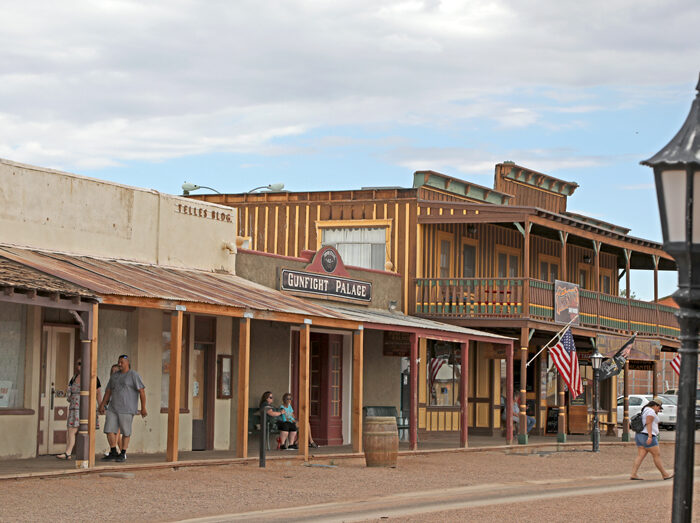
The popular town of Tombstone exists today primarily as a high-level authentic old western mining town; a wonderful tourist attraction that earned having a listing on the National Historic District Landmark protection in 1961. This National Historic District in downtown Tombstone feels like you have just stepped back into Frontier mining times; “The wild and woolly west,” with no cars, with stores located in old style wooden stores that share a wall, with western characters walking around in Frontier costumes, much like Old City Williamsburg.
There are stage coach rides, dramatic gun battles in the street, musicians, businesses with western themes that sell western items or provide theme-styled experiences that appeal to visitors; even a dramatization of the famous gun battle that took place in the OK Corral. Other places also have their own pretend gunfights.
Tombstone Museums to visit include: Gunfighters Historical Museum, Tombstone Western Heritage Museum
The visitor can also take a tour of an old silver mine The Goodenough Silver Mine, one of the biggest money makers in Tombstone’s silver mining community of miners and owners. Some of the other tours that the visitor can take are Tombstone Tour, Tombstone Trolley LLC, and the Apache ATV Tours.
Tombstone also has special events to bring in the visitors as well. In August, there is DOC Holli-DAYS August 9th-11th. In October, 90th Annual Tombstone Helldorado Days is held. There are small hotels and b and b’s where visitors can spend the night here which helps with the tourist trade. The nearest town is Benson, 27 minutes northwest of Tombstone that has 6 hotels.
In Tombstone, not only are the replicas of the historical structures and overall aura historically correct, because of the National Historic District Landmark rules that must be followed, but so are the people who are dressed up to represent all the types of of folks who once lived here. People who live here as residents of Tombstone are enthusiastic participants involved with the tourist trade that keeps Tombstone pumping economically.
The Earp brothers and Doc Holiday walk the streets once again in character, protecting us all. Other participants are dressed like regular respectable town folk, business people and also not so respectable women and the dastardly villains; the cowboys and wily ranchers as well. They all walk around in character or can be seen running businesses found here. All are going about their business, sometimes interacting with tourists.
Visitors can take a walking tour of Tombstone and look at all the markers telling about each building of interest that are not far from each other. The Campbell and Hatch Saloon and Billiard Parlor marker. The Grand Hotel, Owl Cafe and Tourist Hotel; City Marshall Virgil Earp; The Oriental Saloon; Can Can Restaurant; Cochise County Bank; Rose Tree; M. Calisher General Store. Touch for a list and map of all markers in Tombstone.
HISTORY:
The mining town of Tombstone had a beginning like a lot of the towns that sprang up around the mines of silver, lead, copper, and gold, including: Virginia City NV, Bodie CA, Bannack, Mt., Butte, ND, Calico, CA, Jerome, AZ. An army scout, Ed Schieffelin was based out of Camp Huachuca, a fort that was the home base of the Army who were there to protect the people from Apache attacks and to stop such attacks.
Upset about settlers moving into their space and land, Apache raiding parties, led by Geronimo, harassed settlers, stole from them and sometimes killed anyone who dared squatting on their land. This brought the Federal Government into the picture, who established various, strategically placed army/calvary camps that became official U.S. forts. Near the town of Sierra Vista, about 190 miles south of Phoenix, Camp Huachuca was established in 1877, to deter Geronimo’s raids and stop them from escaping into MEXICO.
One of their scouts, was a man called Ed Schieffelin, who had a dangerous hobby that he pursued in his free time, in 1877. Despite being warned against Apache attacks, he started to prospect, looking for silver. His friend kidded him that he should bring his own tombstone along. Undaunted by warnings, Schiefflin hit pay dirt when he discovered pieces of silver ore in a dry wash, in a place called Goose flats, located on top of a mesa. This discovery fueled his enthusiasm, and he earnestly looked for the main source of this silver ore. Eureka! He found his mother lode a few months later; a huge vein of silver that was about fifty feet long and twelve inches wider. On Sept 21st, 1877, Schieffelin registered his legal mining claim, calling his “stake” “Tombstone,” located at the base of the huge mesa.
Soon about 100 prospectors and workers showed up and found their own mines, which resulted in a settlement of tents to spring up at Watervale, near the Lucky Cuss Mine. After the discovery of the huge silver strike at Goodenough Mine, people who were interested in investing in the mines came forward. These very rich in silver and lead mines were becoming the biggest strike in Arizona.
Former Territorial Governor Anson P. K. Safford;(July 9,1869–April 5,1877), who had a long time interest in mining, was one such investor. Governor Safford offered his financial backing for a cut of the profits from the mining claims. With Safford’s investment, Schieffelin, his brother Al, and their partner Richard Gird formed the Tombstone Mining and Milling Company and built a stamp mill near the San Pedro River, about 8 miles away.
Along with the new residents, a downtown, called Tombstone sprang up as well, as soon as the various lots were drawn out for businesses and homes. “Tombstone had a bowling alley, four churches, an ice house, a school, two banks, three newspapers, and an ice cream parlor, alongside 110 saloons, 14 gambling halls, and numerous dance halls and brothels.”
As in any town, classes of people developed. “The gentlemen and ladies of Tombstone , some ranchers and the lawmen attended operas presented by visiting acting troupes at the Schieffelin Hall Opera House.”
The lower classes, made up of mostly miners, some on the edge ranchers, and the outlaw cowboys, saw shows at the Bird Cage Theater and frequented both the card games and the large brothel. Perhaps they visited other brothels and saloons as well.
Law and order was hard to come by at first in Tombstone. The use of the gun became the main tool to permanently settle disputes. They all missed that day in school when anger management and ways of negotiating issues was taught. Hot tempers plus liquor plus the use of guns resulted in a hefty business for the undertaker.
Some ranchers saw the opportunity to make more money illegally by supplementing their income by rustling cattle or smuggling illegal goods in Mexico, and perhaps even had a few enterprises in town. The common and upper class folk and the businesses in town needed more protection if they were going to stay there. The sheriff needed reinforcements to deal with the rowdiness and the bad attitudes that existed toward authority, and other people’s property. Bullying was common.
When Tombstone was named to be the Pima County Seat, the Federal Authorities began to care about the lack of strong law enforcement. The Federal Marshall head called upon Virgil Earp to go to Tombstone as a Federal Deputy Marshall and assist the overworked sheriff of Tombstone. Virgil Earp asked his four brothers to go with him. The case for law and order in Tombstone just got a huge gift.
In 1880, the population of Tombstone soared to 10,000 people, which attracted some high-brow businesses. Besides Kelly’s Wine House that offered a great variety of wines, “the richly appointed Grand Hotel” opened its doors for business as well. This high class joint was a spark of civilization, offering its guests with as much as hotels did in a big city. Guests enjoyed fine oil paintings, thick Brussels carpets, toilet stands, elegant chandeliers, silk-covered furniture, walnut furniture, and a kitchen with hot and cold running water. Acceptable citizens as well as the ranchers loved staying here; both had the money to do so. Apparently, The Grand Hotel served everyone with the money to book a room.
When Tombstone was named to be the Pima County Seat, the Federal Authorities began to care about the lack of strong law enforcement. The Federal Marshall head called upon Virgil Earp to go to Tombstone as a Federal Deputy Marshall and assist the overworked sheriff of Tombstone. Virgil Earp asked his four brothers to go with him. The case for law and order in Tombstone just got a huge gift.
The event that made Tombstone eventually famous was the “Shootout at the OK Corral,” on October 26, 1881. The Cowboys and ranchers repeatedly threatened the Earps over many months until the conflict resulted in this shootout. This famous event between Doc Holiday, Virgil, Wyatt, and Morgan Earp, and the Clantons, the McLaury brothers and Billy Claiborne actually happened in an alley near the OK Coral off Fremont Street.
Virgil came with his posse to make the Clantons, McLaury brothers and Billy Caliborne to give up their guns as there was a “no gun rule in town” being enforced in Tombstone. The feud between The Earps and the ranchers and cowboys continued. No one won between these two groups when this feud finally ended. But the sacrifices made by the Earp side ensured for peace in Tombstone and a future to come. For more details, read the story on The Gunfight in the OK Corral story.
In the mid 1880’s, the mines became deeper, and the water table was reached, and flooding became a problem for the mine owners. They invested significantly in these specialized pumps. These pumps worked beautifully until a nasty fire in 1886 destroyed the Grand Central hoist and the pumping plant, and it was unprofitable to rebuild the costly pumps.
Uh oh, people moved away and Tombstone dwindled in population; to 646 at its lowest number in 1910. The final nail in the coffin might have been in 1914, when all saloons were closed. Instead, This event created the need and planted the seed for people to think outside of the box and create new stores and ways to make money. Tombstone was indeed too tough to die.
Luckily, it managed to stay a town because it remained the Cochise County seat until 1929. Meanwhile, a new source of income to keep the town of Tombstone alive began as well. As early as the 1920’s, accounts of the gun fight at the O.K. Corral were being republished; which led to interviews with those who had lived in Tombstone during its earliest history.
Then came the books; shelves of them. In 1931, two years after Wyatt Earp died, author Stuart Lake published the well-received biography Wyatt Earp: Frontier Marshal. This book inspired “the 1946 film My Darling Clementine, directed by John Ford, and the 1957 film Gunfight at the O.K. Corral, after which the shootout became known by that name”
All this publicity made this shoot-out at the OK Corral an icon of western culture of the good guys against the bad guys, catching the public’s imagination. Western films have leaned heavily on outlaw ranchers and cowboys, plus adding the railroads too; bullying townspeople and the ultimate showdown with law enforcement. Newer western films with these themes include “Support your Local Sheriff”, “High Noon” and “Tombstone.”
People began to visit Tombstone who were willing to spend money; creating the economic lift needed to keep Tombstone going. It didn’t take long for a cottage tourist industry to be born here. Tombstone slowly grew in population as new businesses came to set up shop.
Films and television accelerated the interest in Tombstone. Somewhere along the way Hollywood “discovered” Tombstone, and an “international star was in the making.” Television added more glamour to the public’s impression by introducing the city’s name to millions of viewers every week. The net result was world wide acquaintance with the name of Tombstone.”
The leaders of Tombstone, were proving to be tough entrepreneurs. As early as 1946, Tombstone’s Council took advantage of all this interest, and made investments for the full-scale restoring real fixer upper opportunities & even the ruins of stores, and made Tombstone a true step back in time. In 1961, the National Register of Historic district inspectors came to look over Tombstone and said that Tombstone was the best example of an old west town they had experienced.
After being added to this NRHDL, Tombstone could borrow money to do some more historical sprucing. Over the years, many visitors came to see a historic demonstration of Tombstone; feeling that they actually went back in time. This groundswell of support gave the town of Tombstone its life back again. Tombstone grew to 1,380 by 2010.
HAUNTED PLACES IN TOMBSTONE:
Birdcage Theater
Big Nose Kate’s Saloon
The Buford House
Cafe Margarita
The Crystal Palace Saloon
Larian Motel
OK Corral
Red Buffalo Trading Company
Tombstone Bordello Bed and Breakfast
Tombstone Streets
More Haunted Arizona City Index Pages
JEROME | PIONEER VILLAGE | PRESCOTT | TUCSON